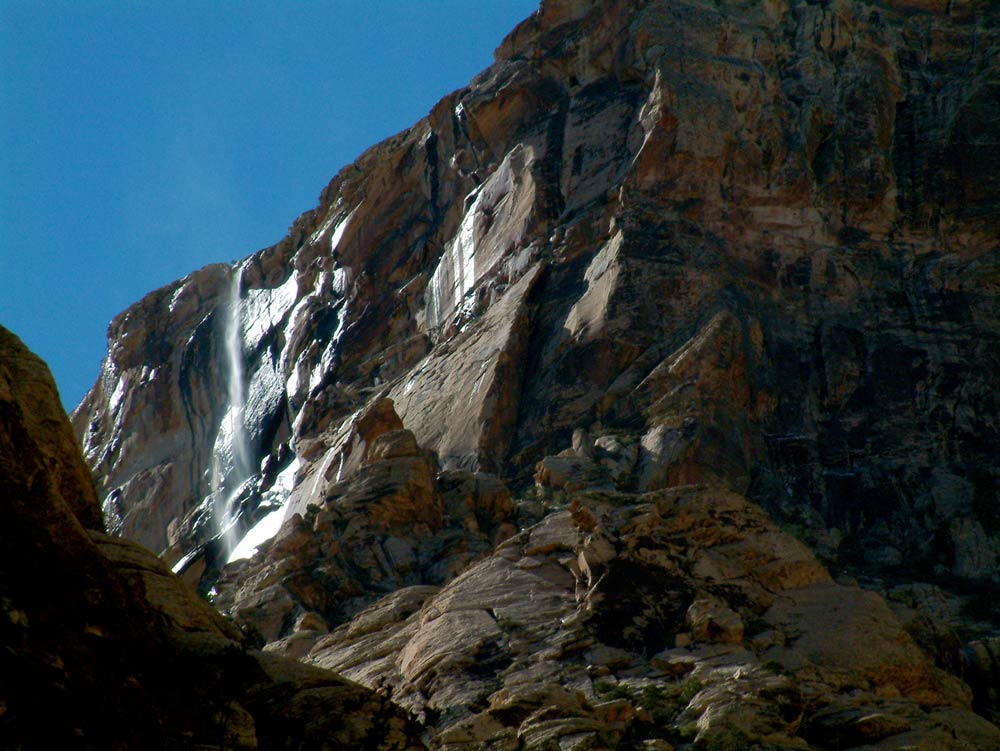
Red Rock Canyon ... consists of a small valley and the mountains that surround it. It is situated on the eastern flanks of the Spring Mountains and is located about 15 miles west of downtown Las Vegas. The Red Rock Canyon National Conservation Area (NCA), as it is known officially extends from north of Mt. Potosi to the north facing parts of the Spring Mountains. Red Rock Canyon is close to downtown and the tourist areas and borders the western suburbs of Las Vegas. Just Red Rock, as it is known to the locals, gets its name from the red  colored sandstone formations embedded in the mountains that form the western and northern margins of this small valley. Red colored layers of sandstone streak horizontally across mountains known as the Wilson Cliffs and can be seen from almost anywhere in Las Vegas valley. colored sandstone formations embedded in the mountains that form the western and northern margins of this small valley. Red colored layers of sandstone streak horizontally across mountains known as the Wilson Cliffs and can be seen from almost anywhere in Las Vegas valley.
While much of the Wilson Cliffs are visible from the Las Vegas Valley, much of what people think of as the Red Rock Canyon is nestled below these mountains and out of the direct line of sight from the Las Vegas Valley. The red sandstones that make Red Rock so unique, is part of the same geologic formation, known as the Navaho Formation, that is also found in the Valley of Fire, Zion National Park and throughout many parts of the southwestern corner of the United States. The contrasts of red sandstone layered through gray limestone is impressive against the tall sheer cliff faces of - as high as - 600 meters or about 1,800 feet. What cannot be seen from a distance are the often surrealistic looking bands of red sandstone that are unique among sandstone formations but common in Red Rock.
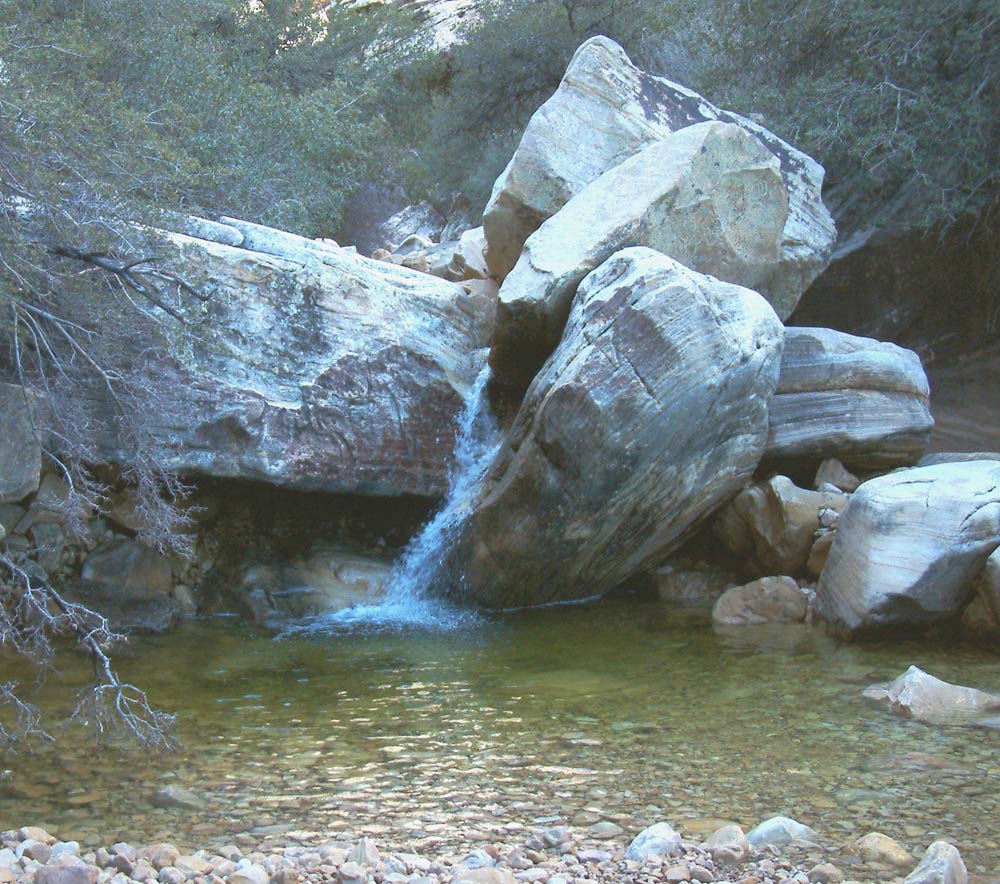
The geologic structure of valley that forms Red Rock Canyon is typical of the Great Basin and the basin and range type of north-south orientation of mountains and valleys found throughout Nevada and many parts of the Southwest. One of the appealing features Red Rock are the many small streams that form during the spring months. The rain and snow that falls on the Spring Mountains finds its way down from the high peaks to form waterfalls, leading to ephemeral streams and pools that eventually find their way into the desert floor. In the spring this makes Red Rock, at least along the base of the Wilson Cliffs, a relatively well watered place. These temporary pools, streams and waterfalls make Red Rock an appealing place for hikers and photographers.
The mountains that make up the western edge of Red Rock,  the Wilson Cliffs, consist of a number of mountains such as Bridge Point, Bridge Mountain, Rainbow Mountain, Mount Wilson, Indecision Peak and Sandstone Mountain. The diversity of these peaks draws thousands of rock climbers and hikers every year and this appeal is not limited by season. Red Rock is generally the Wilson Cliffs, consist of a number of mountains such as Bridge Point, Bridge Mountain, Rainbow Mountain, Mount Wilson, Indecision Peak and Sandstone Mountain. The diversity of these peaks draws thousands of rock climbers and hikers every year and this appeal is not limited by season. Red Rock is generally  cooler than Las Vegas and in the summer, while the visitor volume is less in the summer than in the spring and fall months, is not substantially lower then. cooler than Las Vegas and in the summer, while the visitor volume is less in the summer than in the spring and fall months, is not substantially lower then.
At the north end of this small valley is the BLM 'Scenic Drive' and Visitor Center. To most visitors this is the area thought of as Red Rock Canyon.
Part of the eastern boundary of the small valley that this part of Red Rock Canyon exists in, consists of a series of low hills collectively known as Blue Diamond Hill. Between these mountains and hills is the valley that State Highway 159 runs through. From Highway 159, you can drive though the entire valley that this part of Red Rock occupies.
In the southern part of the this valley is Blue Diamond a mining community. This hamlet is a great place to visit and live because it is close to Las Vegas but is also in Red Rock.
There are a lot of things to do in Red Rock Canyon. If you like to hike, take spectacular pictures or if you want to learn more about the desert, plan to spend some time here. Red Rock Canyon has a lot to offer. Horseback riding at Bonnie Springs Ranch, 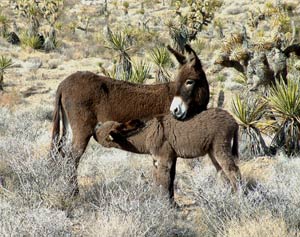 picnicking at places like Willow Springs and rock climbing are very popular. picnicking at places like Willow Springs and rock climbing are very popular.
One of the more popular and serendipitous encounters with nature that might occur in Red Rock Canyon is when you see some of the many burros that live in the 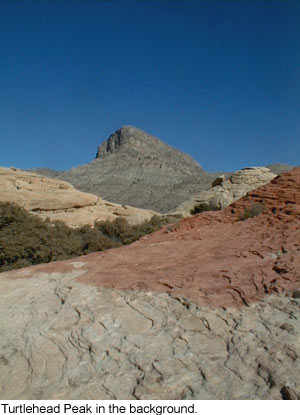 Spring Mountains. These burros often show up in small herds and they tend to be relatively tame. While not indigenous to the area, the burros seem to do very well in Red Rock. Exactly where these burros originally came from is not known with any certainty. In some way they are no doubt from Euro-American settlers or travelers. Some historians speculate that they might be from the herds that were moved along the Spanish Trail in the early 19th century. This is very possible. More likely the origin of these herds has multiple sources, Mormon settlers, miners, wagon trail and also, possibly even from the caravans that crossed the area along the Spanish Trail. Spring Mountains. These burros often show up in small herds and they tend to be relatively tame. While not indigenous to the area, the burros seem to do very well in Red Rock. Exactly where these burros originally came from is not known with any certainty. In some way they are no doubt from Euro-American settlers or travelers. Some historians speculate that they might be from the herds that were moved along the Spanish Trail in the early 19th century. This is very possible. More likely the origin of these herds has multiple sources, Mormon settlers, miners, wagon trail and also, possibly even from the caravans that crossed the area along the Spanish Trail.
Overall Red Rock Canyon offers visitors to and from Las Vegas a refreshing, different and some times unexpected perspective of the region. With horseback rides and sunset barbeque rides available visitors can get a sense of the west that is not found in most places. Seeing burros in the wild is an experience not found in other places. Visitors will also see how the desert can be a place that is not as hostile as once thought and the beauty of the stark environment.
For many Las Vegans Red Rock Canyon is a great day trip where parents can take their kids to both learn about nature and the desert. Since Red Rock is usually about 5 degrees cooler than Las Vegas, it is a great getaway in the summer months. This seen in the dozens of bike riders who travel through Red Rock on Highway 159 or in the huge and steady crowds that drive through the Scenic Loop Drive. With so much to offer Las Vegans and visitors to Las Vegas, the popularity of Red Rock Canyon is understandable and the popularity of Red Rock with visitors is likely to increase.
|